
Effect of Vaasamoola Lepa and Krishna, Vacha, Erandataila Lepa in Prasava (labour) – A randomized controlled study
ABSTRACT:
Background: Labour is a natural process that requires minimal assistance, but due to the altered anatomy and physiology, it may suddenly become abnormal and even fatal. Labour is vastly described in Ayurveda as Prasava and its being practised since centuries. Application of the Ayurvedic concept of labour and its practices is the need of hour in prevention of un toward complications of labour.
Design: This was a randomized comparative clinical study. It included 40 patients assigned into two groups, Group A and Group B each with 40 patients respectively. Group A patients were administered Krishnavacha Lepa mixed with Eranda Taila Lepa and in Group B, Vaasamoola Lepa was applied after attaining the true labour pain in the first stage of labour with proper operative procedures.
Results: Repeated measures analysis of variance (RMANOVA) with Bonferroni showed significant changes both between and within the groups. Krishna Vacha Eranda Taila Lepa showed significant changes compared to Vaasamoola Lepa with (p≤0.05) in Cervical effacement, Cervical Position, Cervical Dilatation, Cervical Consistency, Head Station, Number of contractions and Duration of contractions.
Conclusion: Krishna Vacha Eranda Taila Lepa application was more effective compared to Vaasamoola Lepa in the management of first stage of Prasava in patients with true labour pain.
INTRODUCTION
Every woman on this earth would like to embrace a happy motherhood and it is acknowledged as a dynamic, life-modifying and ongoing process of transition in a woman’s identity, and a permanent transformation of a woman’s life. They like to experience this motherhood with minimal pain, agony and operative aid so that they can continue with their regular duties as earlier. Perinatal mental health problems, such as depression and anxiety has increased due to challenging and the demanding situations of motherhood which strongly influences a woman’s state of mind. This is associated with the antenatal mental health problems that serve as a predictor for ensuing adverse maternal postpartum mental health.
In the past, women used to deliver naturally with healthy babies and healthy genital organs without any complications. Whereas, women in present days are being delivered by an operative method called C- section; Caesarean section (C-section) is the most common procedure practiced in obstetrics worldwide. It is a surgical procedure that is indicated in delivering one or more foetuses via the abdominal wall and uterine incision. According to World Health Organization (WHO), 10-15% deliveries are through the C-section method across the world. American Centre for Disease Control and Prevention states that in 1995 and 2016, the rate of Caesarean delivery has increased from 20.7% to 31.6%. Caesarean delivery is indicated in multiple pregnancies, chorioamnionitis foetal malpresentation etc. and also in anaesthesia-related complications such as drug overdose, apnoea and hypoxia etc.
Labour comprises a sequence of rhythmic, involuntary or medically induced contractions which occurs in three stages that begins from the onset of labour to delivery of the baby and the placenta. Caesarean Delivery has been perceived as a procedure with risks and is designed for women with medical indications. Management of labour includes pharmacological, non-pharmacological treatments and the use of herbal medicine to relieve the labour pain.
Even Ayurvedic science, the traditional medicine has described the process of normal labour and is termed as Sukha Prasava (Easy Labour) which means easy labour and many Paricharyas (Regimen) have been explained by our Acharyas (Teacher) for the same. Apart from Prasava (Labour), our Acharyas have also described about Garbhini Paricharya (Antenatal Care), Prasava Paricharya (Intranatal Care) and Soothika Paricharya (Postnatal Care) in elaboration. Among these, Acharya Vagbhata has explained about Prasava Paricharya (Regimen for Labour). Treatment in Ayurveda involves Sthanika Abhyanga (Local Massage), Swedana (Local Fomentation) and Upaghrana (Snuffing) of compound drugs followed by Dhooma Sevana (Inhalation) during Prasava Kaala (Stages of Labour) i.e. in the first and second stage of labour. This helps the women in bearing and delivering baby easily and in the short period (Adhomukha Sampadana of Garbha – Downward Movement of Baby)) for Sukha Prasava (Easy Labour). Anuvasana Basti (Enema of Decoction) and Pichu (Local Treatmeant) of oil medicated with Madhura Gana Dravyas (Group of Drugs Having Sweet Taste) from the beginning of ninth month of pregnancy for the management of Sukha Prasava (Easy Labour) is also advised by the Acharyas. Lepana (Paste), a type of Sthaanika Chikitsa (Local Treatment) described in Ayurvedic science wherein the drugs employed directly come in contact with the part treated and has proved its efficacy in previous studies. Present study attempted to evaluate the effect of Lepana Chikitsa (Application of Paste) called Krishna Vacha Eranda Taila Lepa and Vaasamoola Lepa application in female patients in the first stage of labour and their effect of the Bishop’s score including Cervical effacement, Cervical position, Cervical dilatation, Cervical Consistency, Head station, Number and Duration of contractions.
OBJECTIVES OF THE STUDY
Objectives of the current study was to review and analyse the literature of Prasava available in Ayurvedic texts, analyse parturition described in Modern medical science and to evaluate the clinical efficacy of Krishna Vacha, Erandataila lepa and Vaasamoola lepa in the management of Prasava and to evaluate its comparative effects on cervical effacement, cervical position, cervical dilatation, cervical consistency, head station, number of contractions and duration of contractions in female patients of first stage of labour.
MATERIALS AND METHODS
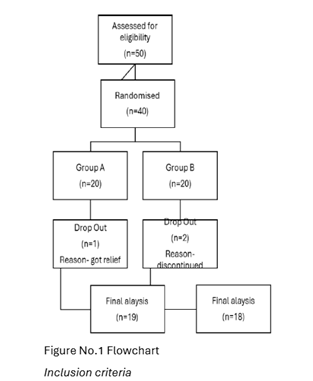
This was a randomized comparative clinical trial that included 40 patients assigned into two groups, Group A and Group B each with 40 patients respectively. (Figure 1: Flowchart) Sample size was derived by calculating the effect size based on the mean and standard deviation (SD) of an earlier clinical study conducted on the Prasava (Labour) and Ayurvedic intervention. Randomization was done using a computer-generated random number table on the www. randomizer.org software. Pregnant women with true labour pain in the first stage of labour were recruited from the outpatient and in-patient Department of Prasooti Tantra Evam Stree Roga at R.G.E.S Ayurvedic Medical College and hospital Ron. After the initial screening, patients who fulfilled the eligible criteria were assigned into the groups. The study was approved by the Institutional Review Board of Institutional Ethical committee of R.G.E.S Ayurvedic Medical College and hospital Ron. Signed informed consent was obtained from all the patients. Statistician who did data analysis and the researcher who carried out the assessments were blinded to the treatment status of the patients. Statistical analysis was done using appropriate statistical methods and results were interpreted.
Inclusion criteria
Pregnant women between the age groups of 22yrs- 35yrs, female patients with true labour pain in the first stage of labour, primigravida with cephalic presentation, patients having normal pelvic measurement, patients who was co-operative and had willingness to undergo the ayurvedic treatment and primigravida with cervical dilatation less than 2cms were included for the study.
Exclusion criteria
CPD, multiparous women, malpresentation, placenta previa, APH, high risk pregnancy including jaundice, pre-eclampsia, anaemia etc. Elderly primi-gravida, pre-existing diseases like dm, heart disease etc and cervical dilatation more than 2cms were excluded.
Intervention
Table No.1 showing Intervention
| Group | Group A | Group B |
|---|---|---|
| Pūrva Karma | Informed consent obtained | Informed consent obtained |
| Asked to consume light food | Asked to consume light food | |
| Lepa | Krishna Vacha, Erandataila Lepa application | Vaasamoola Lepa application |
| Duration | Pratiloma gati (opposite direction) | Pratiloma gati (opposite direction) |
| Thickness | 4-5mm | 4-5mm |
| Observation of Pralakshanas | After lepa application | After lepa application |
In Group A, the nature of the treatment was explained to the patient in detail before conducting the procedure. Patient was mentally prepared for the procedure by giving assurance. Informed consent was obtained from all the patients. As a preoperative measure, patient was advised to consume light food. Required materials were collected and Lepa (Paste) was prepared and the area of application of the Lepa (Paste) such as periumbilical region, groin and pelvic region was cleaned and kept ready. Patient was made to lie down comfortably on the table. Krishna Vacha, Erandataila Lepa was applied on periumbilical region, groin and pelvic region in the Pratiloma Gati (Opposite Direction) for the thickness of 4 -5 mm after the onset of true labour pain. Lepa was removed and the area was cleaned. Observation of Pralakshana (Cleansing) was done in the place of Lepa application. Whereas in Group B, Vaasamoola Lepa was applied on periumbilical region, groin and pelvic region in the Pratiloma Gati for the thickness of 4 -5 mm after the onset of true labour pain. Lepa was removed and the area was cleaned. Observation of Pralakshana was done in the place of Lepa application.
Assessment criteria
Cervical effacement, cervical dilatation, cervical consistency, head station, number of contractions and duration of contractions was assessed before and after the treatment at the interval of 3hrs, 6hrs and 9hrs. Cervical position was recorded before and after the treatment at anterior, mid and posterior positions. Parameters were graded before, during and after the treatment. (Table No.1 and 2)
Parameters
- Bishop’s Score (Table No.1)
• Cervical effacement
• Cervical position
• Cervical dilatation
• Cervical Consistency
• Head Station - Number of Contractions
- Duration of Contractions
Table No.2 Bishop’s Scoring
Each component was given a score of 0-3. The highest possible score is 13.
| SCORE | 0 | 1 | 2 | 3 |
|---|---|---|---|---|
| CERVICAL EFFACEMENT |
< 30% | 40 - 50% | 60 – 70% | 80% + |
| CERVICAL POSITION |
POSTERIOR | MIDDLE | ANTERIOR | – |
| CERVICAL DILATATION |
CLOSED | 1-2 cms | 3-4 cms | 5 cms + |
| CERVICAL CONSISTENCY |
FIRM | MEDIUM | SOFT | – |
| HEAD STATION | -3 | -2, -1 | 0 | +1, +2 |
Interpretation: Each component was given a score of 0-3. The highest possible score is 13. A score of 5 or less suggests that labour is unlikely to start without induction. A score of 9 or more indicates that labour will most likely commence spontaneously. A low Bishop’s score often indicates that induction is unlikely to be successful. Some sources indicate that only a score of 8 or greater is reliably predictive of a successful induction.
Table No. 3 Grading of Parameters
| Sl.No | Parameters | Grading | |
|---|---|---|---|
| 1. | Cervical effacement | 0 to 25% | 3 |
| 26 to 50% | 2 | ||
| 51 to 70% | 1 | ||
| o 100% | 0 | ||
| 2. | Cervical position | Posterior | 2 |
| Mild | 1 | ||
| 3. | Cervical dilatation | 0 - 2cm | 4 |
| 2 - 4cm | 3 | ||
| 4 - 6cm | 2 | ||
| 6 - 8cm | 1 | ||
| -10cm | 0 | ||
| 4. | Cervical Consistency | Firm | 2 |
| Medium | 1 | ||
| Soft | 0 | ||
| 5. | Head Station | -1 station | 4 |
| 0 station | 3 | ||
| + 1 station | 2 | ||
| +2 station | 1 | ||
| +3 station | 0 | ||
| 6. | Number of Contractions | 1/10 minutes | 3 |
| 2/10 minutes | 2 | ||
| 3/10 minutes | 1 | ||
| 4/10 minutes | 0 | ||
| 7. | Duration of Contractions | 30-45 sec | 3 |
| 46-60 sec | 2 | ||
| 61-75 sec | 1 | ||
| 76-90 sec | 0 |
RESULTS
Forty patients with the features of true labour pain in the first stage of labour were included for the study. There was 1 drop out in group A and 2 in the group B and the analysis was carried out on 37 patients. Kolmogorov Smirnov Test for Normality was conducted from values computed as difference between baseline and post values. The data was normally distributed. Repeated measures Analysis of Variance was performed to assess the difference between the two groups and two timepoints.
Between the groups, repeated measures analysis of variance (RMANOVA) with Bonferroni showed significant changes in Group A (Krishna Vacha Eranda Taila Lepa) on cervical effacement, cervical dilatation, consistency, position of the cervix, head station, number of contractions and duration of contractions compared to Group B (Vaasamoola lepa) with all the parameters (p≤0.05). Whereas, within the groups, significant difference was observed in both the groups in cervical effacement, cervical position, cervical Dilatation, cervical consistency, head station, number of contractions and duration of contractions after the treatment at 6 hours (p≤0.05) and 9 hours (p≤0.05) with more reduction in group A compared to group B. (Table 4)
Table No.4 Results Within and Between Groups
| Group A | Group B | |||||
|---|---|---|---|---|---|---|
| 3rd Hour | 6th Hour | 9th Hour | 3rd Hour | 6th Hour | 9th Hour | |
| CE | 3.0±0.0 | 0.89±0.32 | 0.00±0.00 | 3.00±0.0 | 2.61±0.5 | 0.97±1 |
| CP | 2.0±0.0 | 0.79±0.00.42 | 0.0±0.0 | 2.0±0.0 | 1.56±0.5 | 0.46±0.6 |
| CD | 4.0±0.0 | 1.53±0.51 | 0.26±0.45 | 4.0±0.0 | 2.83±0.38 | 1.89±0.32 |
| CC | 2.0±0.0 | 0.63±0.5 | 0.0±0.0 | 2.0±0.0 | 1.06±0.24 | 0.51±0.56 |
| HS | 4.0±0.0 | 2.26±0.45 | 0.42±0.51 | 4.0±0.0 | 2.89±0.32 | 1.11±0.84 |
| NC | 3.0±0.0 | 0.89±0.32 | 1.89±0.32 | 3.0±0.0 | 0.0±0.0 | 1.28±0.46 |
| DC | 3.0±0.0 | 0.84±0.36 | 0.00±0.00 | 3.0±0.0 | 1.46±0.73 | 1.22±0.43 |
CF- Cervical Effacement, CP-Cervical Position, CD- Cervical Dilatation, CC- Cervical Consistency, HSHead Station, NC-Number of Contractions, DC-Duration of Contractions
DISCUSSION
Ayurveda Acharyas have described in detail about both the Prasuti and Streeroga which comes under the branch of Obstetrics and Gynaecology branch of Modern medicine. This branch helps in aiding the healthy pregnancy and a healthy progeny. Normal labour is the one that occurs through vagina without any maternal or foetal complications. Mechanism and stages of normal labour are vividly explained by the Modern science. People hardly know about the Ayurvedic concept of Prasava (Labour) or the Sukha Prasava. Even in Ayurvedic science, Prasava (Labour), stages of labour and the monthly wise specific regimen is explained under the name Prasava Paricharya. Various Acharyas of Ayurveda have described about Prasava and its management.
The present study evaluates the role of Krishna Vacha Eranda Taila Lepa and Vaasamoola Lepa in the management of first stage of labour in patients having true labour pain. It included the total of 19 and 18 subjects for data analysis in group A and group B respectively. The data was normally distributed. Repeated measures Analysis of Variance was performed to assess the difference between the two groups and within the groups.
Pregnancy, parturition and puerperium are the three main phases of woman’s active reproductive life. Among which parturition is the one that needs highest attention and consideration. Labour is a natural process that requires very little assistance. However, sometimes the normal labour may suddenly become abnormal and even fatal. The present study deals with aiding “a mother to be” woman to pass through a normal labour, unhindered and uncomplicated, without hinderance and without risk to the life of the mother and child. [20] With this objective in the present study, Krishnavacha Lepa with Erandataila mentioned in Astanga Samgraha was taken to know its efficacy on Prasava and this was compared with Vaasamoola Lepa. Lepa Chikitsa is a common form of Sthaanika Chikitsa (Local Treatment), wherein the drugs employed come directly in contact with the part or the structure was an anticipated response is required. Here, Krishna Vacha Eranda Taila Yoni Lepana (Paste Application) was used with the intention of enhancing the dilatation and effacement of the cervix. In the method employed, patients were closely monitored to elicit the exact response to the drugs employed and hence during the first stage of labor p/v examination was carried once in every three hours, 6 hours and at 9 hours. Further, the biochemical analysis of Krishna Vacha Eranda Taila Lepa showed that it is rubeficiant and therefore facilitates effacement and dilatation of cervix and also increases uterine contraction.
Lepa or Anointment of Pippali (Piper longum), vacha (Acorus calamus), pestle with water and mixed with Eranda Taila (Ricinus Communis) over the umbilicus induces labor pains. It may act by local stimulation of abdominal muscles and there by the uterine muscles to contract well. Pippali is known to have anti-diarrheal, muscle relaxant, analgesic, anti-spasmodic properties which may relax the smooth muscle by blocking the cyclo-oxygenase and relieves the pain. Thus, Krishna Vacha being Sthambhaka and Vata Shamaka, reduced the pain and premature contractions by its well-established anti-inflammatory, analgesic and anti-spasmodic activity. [21] The varied studies of Pippali shows that the crude extract, the active fraction of the powdered fruits of Piper longum were studied for the antifertility effect in female rats. Vacha or the calamus root contains high levels of essential oils with decadienal, catyophyllene, humulene, curcumin and Basarone and bitter agents such as acorone, neoacorone, acorine, tanning agents and mucilage. These all are oxytocic in nature which accelerates the contractility of the muscles and shown to increase the receptors of oxytocin in the myometrium.
A potent cathartic, castor oil was used by Ancient Egyptians to stimulate labour. It was widely used as a traditional method of initiating labour in midwifery practice in India and various countries. It is observed that on local application, it stimulates the nerve pathway resulting in delivery. The contractile response is initiated through the alpha- receptors of the post ganglionic nerve fibres in and around the cervix. [4] Few studies have shown the uterotonic activity of Vaasa or vasicine in different species of animals in vitro was similar to oxytocin & methylergometrin. Vasicine is said to cause contraction and rhythmic contractile movements of uterus that causes abortificient activity in laboratory animals without undesirable effects. [22] In the present study, Repeated measures analysis of variance (RMANOVA) with Bonferroni showed significant changes both within and between the groups. Changes in Group A (Krishna Vacha Eranda Taila Lepa) showed in Cervical effacement, Cervical Position, Cervical dilatation, Cervical Consistency, Head Station, Number of contractions and Duration of contractions compared to Group B (Vaasamoola lepa) with all the parameters (p≤0.05).
Limitations
Strengths
One of its kind of study as it included ayurvedic intervention in both the groups. Unique study as it is conducted on Prasava (Labour) in which 99% cases of labour are managed only with conventional management of modern medicine. No adverse effects were observed with both Vaasamoola and Krishna Vacha Eranda Taila Lepa application. Safe and effective. Patients were happy as they could witness less pain. Patients were strongly recommending the approach of treatment and the efficacy of ayurveda treatment in labour and pregnancy to other patients who were admitted at the hospital.
Recommendations
A larger study can be conducted with larger sample size. A longer follow up would be good. Study can be conducted at different centres so that these valuable Ayurvedic medicines can be employed for the welfare of society in the days ahead. Further analytical studies should be conducted along with clinical study to assess the effects of the drugs to make the study more scientific and evidence based.
CONCLUSION
This was a randomized comparative clinical study. It included 40 patients assigned into two groups, Group A and Group B each with 20 patients respectively. Group A patients were administered Krishnavacha Lepa mixed with Eranda Taila Lepa and applied after attaining the true labour pain in the first stage of labour. In Group B, Vaasamoola Lepa was applied after attaining the true labour pain in the first stage of labour with the proper Purva Karma, Pradhana Karma and Paschat Karma procedures. Repeated measures analysis of variance (RMANOVA) with Bonferroni showed significant changes both between and within the groups. Between the groups, Group A showed significant changes compared to Group B with (p≤0.05) in all the parameters such as Cervical effacement, Cervical Position, Cervical Dilatation, Cervical Consistency, Head Station, Number of contractions and Duration of contractions. Within the groups, both Group A and Group B showed significant changes in post-treatment and during the treatment results compared to pre-treatment with (p≤0.05) in all the parameters. This study shows that the Krishna Vacha Eranda Taila Lepa application was more effective compared to Vaasamoola Lepa in the management of first stage of Prasava in patients with true labour pain.
RESULTS
Forty patients with the features of true labour pain in the first stage of labour were included for the study. There was 1 drop out in group A and 2 in the group B and the analysis was carried out on 37 patients. Kolmogorov Smirnov Test for Normality was conducted from values computed as difference between baseline and post values. The data was normally distributed. Repeated measures Analysis of Variance was performed to assess the difference between the two groups and two timepoints.
Between the groups, repeated measures analysis of variance (RMANOVA) with Bonferroni showed significant changes in Group A (Krishna Vacha Eranda Taila Lepa) on cervical effacement, cervical dilatation, consistency, position of the cervix, head station, number of contractions and duration of contractions compared to Group B (Vaasamoola lepa) with all the parameters (p≤0.05). Whereas, within the groups, significant difference was observed in both the groups in cervical effacement, cervical position, cervical Dilatation, cervical consistency, head station, number of contractions and duration of contractions after the treatment at 6 hours (p≤0.05) and 9 hours (p≤0.05) with more reduction in group A compared to group B. (Table 4)
Table No.4 Results Within and Between Groups
| Group A | Group B | |||||
|---|---|---|---|---|---|---|
| 3rd Hour | 6th Hour | 9th Hour | 3rd Hour | 6th Hour | 9th Hour | |
| CE | 3.0±0.0 | 0.89±0.32 | 0.00±0.00 | 3.00±0.0 | 2.61±0.5 | 0.97±1 |
| CP | 2.0±0.0 | 0.79±0.00.42 | 0.0±0.0 | 2.0±0.0 | 1.56±0.5 | 0.46±0.6 |
| CD | 4.0±0.0 | 1.53±0.51 | 0.26±0.45 | 4.0±0.0 | 2.83±0.38 | 1.89±0.32 |
| CC | 2.0±0.0 | 0.63±0.5 | 0.0±0.0 | 2.0±0.0 | 1.06±0.24 | 0.51±0.56 |
| HS | 4.0±0.0 | 2.26±0.45 | 0.42±0.51 | 4.0±0.0 | 2.89±0.32 | 1.11±0.84 |
| NC | 3.0±0.0 | 0.89±0.32 | 1.89±0.32 | 3.0±0.0 | 0.0±0.0 | 1.28±0.46 |
| DC | 3.0±0.0 | 0.84±0.36 | 0.00±0.00 | 3.0±0.0 | 1.46±0.73 | 1.22±0.43 |
CF- Cervical Effacement, CP-Cervical Position, CD- Cervical Dilatation, CC- Cervical Consistency, HSHead Station, NC-Number of Contractions, DC-Duration of Contractions
DISCUSSION
Ayurveda Acharyas have described in detail about both the Prasuti and Streeroga which comes under the branch of Obstetrics and Gynaecology branch of Modern medicine. This branch helps in aiding the healthy pregnancy and a healthy progeny. Normal labour is the one that occurs through vagina without any maternal or foetal complications. Mechanism and stages of normal labour are vividly explained by the Modern science. People hardly know about the Ayurvedic concept of Prasava (Labour) or the Sukha Prasava. Even in Ayurvedic science, Prasava (Labour), stages of labour and the monthly wise specific regimen is explained under the name Prasava Paricharya. Various Acharyas of Ayurveda have described about Prasava and its management.
The present study evaluates the role of Krishna Vacha Eranda Taila Lepa and Vaasamoola Lepa in the management of first stage of labour in patients having true labour pain. It included the total of 19 and 18 subjects for data analysis in group A and group B respectively. The data was normally distributed. Repeated measures Analysis of Variance was performed to assess the difference between the two groups and within the groups.
Pregnancy, parturition and puerperium are the three main phases of woman’s active reproductive life. Among which parturition is the one that needs highest attention and consideration. Labour is a natural process that requires very little assistance. However, sometimes the normal labour may suddenly become abnormal and even fatal. The present study deals with aiding “a mother to be” woman to pass through a normal labour, unhindered and uncomplicated, without hinderance and without risk to the life of the mother and child. [20] With this objective in the present study, Krishnavacha Lepa with Erandataila mentioned in Astanga Samgraha was taken to know its efficacy on Prasava and this was compared with Vaasamoola Lepa. Lepa Chikitsa is a common form of Sthaanika Chikitsa (Local Treatment), wherein the drugs employed come directly in contact with the part or the structure was an anticipated response is required. Here, Krishna Vacha Eranda Taila Yoni Lepana (Paste Application) was used with the intention of enhancing the dilatation and effacement of the cervix. In the method employed, patients were closely monitored to elicit the exact response to the drugs employed and hence during the first stage of labor p/v examination was carried once in every three hours, 6 hours and at 9 hours. Further, the biochemical analysis of Krishna Vacha Eranda Taila Lepa showed that it is rubeficiant and therefore facilitates effacement and dilatation of cervix and also increases uterine contraction.
Lepa or Anointment of Pippali (Piper longum), vacha (Acorus calamus), pestle with water and mixed with Eranda Taila (Ricinus Communis) over the umbilicus induces labor pains. It may act by local stimulation of abdominal muscles and there by the uterine muscles to contract well. Pippali is known to have anti-diarrheal, muscle relaxant, analgesic, anti-spasmodic properties which may relax the smooth muscle by blocking the cyclo-oxygenase and relieves the pain. Thus, Krishna Vacha being Sthambhaka and Vata Shamaka, reduced the pain and premature contractions by its well-established anti-inflammatory, analgesic and anti-spasmodic activity. [21] The varied studies of Pippali shows that the crude extract, the active fraction of the powdered fruits of Piper longum were studied for the antifertility effect in female rats. Vacha or the calamus root contains high levels of essential oils with decadienal, catyophyllene, humulene, curcumin and Basarone and bitter agents such as acorone, neoacorone, acorine, tanning agents and mucilage. These all are oxytocic in nature which accelerates the contractility of the muscles and shown to increase the receptors of oxytocin in the myometrium.
A potent cathartic, castor oil was used by Ancient Egyptians to stimulate labour. It was widely used as a traditional method of initiating labour in midwifery practice in India and various countries. It is observed that on local application, it stimulates the nerve pathway resulting in delivery. The contractile response is initiated through the alpha- receptors of the post ganglionic nerve fibres in and around the cervix. [4] Few studies have shown the uterotonic activity of Vaasa or vasicine in different species of animals in vitro was similar to oxytocin & methylergometrin. Vasicine is said to cause contraction and rhythmic contractile movements of uterus that causes abortificient activity in laboratory animals without undesirable effects. [22] In the present study, Repeated measures analysis of variance (RMANOVA) with Bonferroni showed significant changes both within and between the groups. Changes in Group A (Krishna Vacha Eranda Taila Lepa) showed in Cervical effacement, Cervical Position, Cervical dilatation, Cervical Consistency, Head Station, Number of contractions and Duration of contractions compared to Group B (Vaasamoola lepa) with all the parameters (p≤0.05).
Limitations
Strengths
One of its kind of study as it included ayurvedic intervention in both the groups. Unique study as it is conducted on Prasava (Labour) in which 99% cases of labour are managed only with conventional management of modern medicine. No adverse effects were observed with both Vaasamoola and Krishna Vacha Eranda Taila Lepa application. Safe and effective. Patients were happy as they could witness less pain. Patients were strongly recommending the approach of treatment and the efficacy of ayurveda treatment in labour and pregnancy to other patients who were admitted at the hospital.
Recommendations
A larger study can be conducted with larger sample size. A longer follow up would be good. Study can be conducted at different centres so that these valuable Ayurvedic medicines can be employed for the welfare of society in the days ahead. Further analytical studies should be conducted along with clinical study to assess the effects of the drugs to make the study more scientific and evidence based.
CONCLUSION
This was a randomized comparative clinical study. It included 40 patients assigned into two groups, Group A and Group B each with 20 patients respectively. Group A patients were administered Krishnavacha Lepa mixed with Eranda Taila Lepa and applied after attaining the true labour pain in the first stage of labour. In Group B, Vaasamoola Lepa was applied after attaining the true labour pain in the first stage of labour with the proper Purva Karma, Pradhana Karma and Paschat Karma procedures. Repeated measures analysis of variance (RMANOVA) with Bonferroni showed significant changes both between and within the groups. Between the groups, Group A showed significant changes compared to Group B with (p≤0.05) in all the parameters such as Cervical effacement, Cervical Position, Cervical Dilatation, Cervical Consistency, Head Station, Number of contractions and Duration of contractions. Within the groups, both Group A and Group B showed significant changes in post-treatment and during the treatment results compared to pre-treatment with (p≤0.05) in all the parameters. This study shows that the Krishna Vacha Eranda Taila Lepa application was more effective compared to Vaasamoola Lepa in the management of first stage of Prasava in patients with true labour pain.
DISCUSSION
Ayurveda Acharyas have described in detail about both the Prasuti and Streeroga which comes under the branch of Obstetrics and Gynaecology branch of Modern medicine. This branch helps in aiding the healthy pregnancy and a healthy progeny. Normal labour is the one that occurs through vagina without any maternal or foetal complications. Mechanism and stages of normal labour are vividly explained by the Modern science. People hardly know about the Ayurvedic concept of Prasava (Labour) or the Sukha Prasava. Even in Ayurvedic science, Prasava (Labour), stages of labour and the monthly wise specific regimen is explained under the name Prasava Paricharya. Various Acharyas of Ayurveda have described about Prasava and its management.
The present study evaluates the role of Krishna Vacha Eranda Taila Lepa and Vaasamoola Lepa in the management of first stage of labour in patients having true labour pain. It included the total of 19 and 18 subjects for data analysis in group A and group B respectively. The data was normally distributed. Repeated measures Analysis of Variance was performed to assess the difference between the two groups and within the groups.
Pregnancy, parturition and puerperium are the three main phases of woman’s active reproductive life. Among which parturition is the one that needs highest attention and consideration. Labour is a natural process that requires very little assistance. However, sometimes the normal labour may suddenly become abnormal and even fatal. The present study deals with aiding “a mother to be” woman to pass through a normal labour, unhindered and uncomplicated, without hinderance and without risk to the life of the mother and child. [20] With this objective in the present study, Krishnavacha Lepa with Erandataila mentioned in Astanga Samgraha was taken to know its efficacy on Prasava and this was compared with Vaasamoola Lepa. Lepa Chikitsa is a common form of Sthaanika Chikitsa (Local Treatment), wherein the drugs employed come directly in contact with the part or the structure was an anticipated response is required. Here, Krishna Vacha Eranda Taila Yoni Lepana (Paste Application) was used with the intention of enhancing the dilatation and effacement of the cervix. In the method employed, patients were closely monitored to elicit the exact response to the drugs employed and hence during the first stage of labor p/v examination was carried once in every three hours, 6 hours and at 9 hours. Further, the biochemical analysis of Krishna Vacha Eranda Taila Lepa showed that it is rubeficiant and therefore facilitates effacement and dilatation of cervix and also increases uterine contraction.
Lepa or Anointment of Pippali (Piper longum), vacha (Acorus calamus), pestle with water and mixed with Eranda Taila (Ricinus Communis) over the umbilicus induces labor pains. It may act by local stimulation of abdominal muscles and there by the uterine muscles to contract well. Pippali is known to have anti-diarrheal, muscle relaxant, analgesic, anti-spasmodic properties which may relax the smooth muscle by blocking the cyclo-oxygenase and relieves the pain. Thus, Krishna Vacha being Sthambhaka and Vata Shamaka, reduced the pain and premature contractions by its well-established anti-inflammatory, analgesic and anti-spasmodic activity. [21] The varied studies of Pippali shows that the crude extract, the active fraction of the powdered fruits of Piper longum were studied for the antifertility effect in female rats. Vacha or the calamus root contains high levels of essential oils with decadienal, catyophyllene, humulene, curcumin and Basarone and bitter agents such as acorone, neoacorone, acorine, tanning agents and mucilage. These all are oxytocic in nature which accelerates the contractility of the muscles and shown to increase the receptors of oxytocin in the myometrium.
A potent cathartic, castor oil was used by Ancient Egyptians to stimulate labour. It was widely used as a traditional method of initiating labour in midwifery practice in India and various countries. It is observed that on local application, it stimulates the nerve pathway resulting in delivery. The contractile response is initiated through the alpha- receptors of the post ganglionic nerve fibres in and around the cervix. [4] Few studies have shown the uterotonic activity of Vaasa or vasicine in different species of animals in vitro was similar to oxytocin & methylergometrin. Vasicine is said to cause contraction and rhythmic contractile movements of uterus that causes abortificient activity in laboratory animals without undesirable effects. [22] In the present study, Repeated measures analysis of variance (RMANOVA) with Bonferroni showed significant changes both within and between the groups. Changes in Group A (Krishna Vacha Eranda Taila Lepa) showed in Cervical effacement, Cervical Position, Cervical dilatation, Cervical Consistency, Head Station, Number of contractions and Duration of contractions compared to Group B (Vaasamoola lepa) with all the parameters (p≤0.05).
Limitations
Strengths
One of its kind of study as it included ayurvedic intervention in both the groups. Unique study as it is conducted on Prasava (Labour) in which 99% cases of labour are managed only with conventional management of modern medicine. No adverse effects were observed with both Vaasamoola and Krishna Vacha Eranda Taila Lepa application. Safe and effective. Patients were happy as they could witness less pain. Patients were strongly recommending the approach of treatment and the efficacy of ayurveda treatment in labour and pregnancy to other patients who were admitted at the hospital.
Recommendations
A larger study can be conducted with larger sample size. A longer follow up would be good. Study can be conducted at different centres so that these valuable Ayurvedic medicines can be employed for the welfare of society in the days ahead. Further analytical studies should be conducted along with clinical study to assess the effects of the drugs to make the study more scientific and evidence based.
CONCLUSION
This was a randomized comparative clinical study. It included 40 patients assigned into two groups, Group A and Group B each with 20 patients respectively. Group A patients were administered Krishnavacha Lepa mixed with Eranda Taila Lepa and applied after attaining the true labour pain in the first stage of labour. In Group B, Vaasamoola Lepa was applied after attaining the true labour pain in the first stage of labour with the proper Purva Karma, Pradhana Karma and Paschat Karma procedures. Repeated measures analysis of variance (RMANOVA) with Bonferroni showed significant changes both between and within the groups. Between the groups, Group A showed significant changes compared to Group B with (p≤0.05) in all the parameters such as Cervical effacement, Cervical Position, Cervical Dilatation, Cervical Consistency, Head Station, Number of contractions and Duration of contractions. Within the groups, both Group A and Group B showed significant changes in post-treatment and during the treatment results compared to pre-treatment with (p≤0.05) in all the parameters. This study shows that the Krishna Vacha Eranda Taila Lepa application was more effective compared to Vaasamoola Lepa in the management of first stage of Prasava in patients with true labour pain.
CONCLUSION
This was a randomized comparative clinical study. It included 40 patients assigned into two groups, Group A and Group B each with 20 patients respectively. Group A patients were administered Krishnavacha Lepa mixed with Eranda Taila Lepa and applied after attaining the true labour pain in the first stage of labour. In Group B, Vaasamoola Lepa was applied after attaining the true labour pain in the first stage of labour with the proper Purva Karma, Pradhana Karma and Paschat Karma procedures. Repeated measures analysis of variance (RMANOVA) with Bonferroni showed significant changes both between and within the groups. Between the groups, Group A showed significant changes compared to Group B with (p≤0.05) in all the parameters such as Cervical effacement, Cervical Position, Cervical Dilatation, Cervical Consistency, Head Station, Number of contractions and Duration of contractions. Within the groups, both Group A and Group B showed significant changes in post-treatment and during the treatment results compared to pre-treatment with (p≤0.05) in all the parameters. This study shows that the Krishna Vacha Eranda Taila Lepa application was more effective compared to Vaasamoola Lepa in the management of first stage of Prasava in patients with true labour pain.
Comments are closed